Alright, research warriors and science adventurers! Kai Rivera here, Chief Investigative Scribe at Peptides.today, and boy, do I have a wild ride for you today. The S2 peptide just changed everything we know about cells and tissues. Have you ever wondered what is really holding you together? No, not your crippling coffee addiction (though, same!), but like, physically holding your cells, tissues, and organs in perfect harmony? Well, buckle up, buttercups, because we are about to dive headfirst into the magnificent, slightly chaotic, and utterly essential world of the Extracellular Matrix (ECM). The S2 peptide lets us watch this magic happen live.
Think of your body’s cells like a bustling city. They need streets to move on, buildings to stick to, and a whole infrastructure to keep things running smoothly. That infrastructure? That is your ECM! It is this crazy complex, super important network of stuff outside your cells, kinda like the ultimate biological scaffolding or the world’s most intricate spiderweb. And one of the biggest, baddest, most foundational proteins in this whole cellular cityscape is called fibronectin (FN). The peptide sticks right to fibronectin. It is like the master architect, laying down the groundwork for other ECM proteins to join the party. Scientists use the peptide to see fibronectin build fibrils in real time.
But here is the rub: watching fibronectin do its thing, seeing how it builds these incredible fibril structures, has been harder than finding a quiet corner at a comic convention. It is like trying to watch a ninja assemble a super-secret LEGO castle in the dark. We know it happens. We know it is crucial for everything from healing wounds to not getting certain diseases. But actually seeing it in real-time? That has been the holy grail. The peptide changes all that with its glowy tag.
Enter our hero, the tiny, unassuming peptide. This is not just any peptide. It is like the ultimate spy drone we have been waiting for! Scientists figured out how to make the S2 peptide stick directly to fibronectin as it is being built. And get this: they even slapped a glowy, fluorescent tag onto the S2 peptide. What does that mean? It means for the first time, we can essentially put tiny night-vision goggles on our cells. We watch fibronectin’s construction crew in action! This peptide is a game-changer, folks. It acts as a molecular magnifying glass. It could help us finally understand and maybe even fix what goes wrong in sneaky diseases like fibrosis.
Okay, tangent time: ready to dive into the nitty-gritty? Let’s dig deeper into this mind-blowing S2 peptide discovery!

Alright, let’s get granular. The Extracellular Matrix (ECM) is not just some fluffy filler. It is a super expansive network, a veritable jungle gym made of complex polymers (think long, chain-like molecules) that surround our cells. It is not just a passive support system. It is an active participant in cellular life, a constant chatterbox for cell adhesion (how cells stick together), migration (how they move around), and tissue morphogenesis (how tissues form and shape up). The peptide reveals how ECM talks to cells. Seriously, it is like the ultimate biological command center. It whispers instructions to cells, telling them where to go and what to do.
Picture it like the most amazing, dynamic 3D puzzle you have ever seen. This puzzle is made up of different pieces. There is collagen, which gives tissues their strength (think super-strong ropes). Elastin lets tissues stretch and snap back (like rubber bands in your skin). A whole bunch of proteoglycans act like super-sponges that hold water, keeping things squishy and bouncy. And then there is our star, fibronectin, doing its thing, pulling it all together. The peptide binds to fibronectin perfectly. When this intricate network gets messed up, especially when too much of certain proteins like fibronectin accumulate, that is when we start seeing trouble, like in various fibrotic diseases.
Now, let’s zoom in on why the S2 peptide matters so much for ECM. Researchers discovered the S2 peptide through smart techniques. It binds specifically to growing fibronectin fibrils. This binding lets them track every step. Before the peptide, we guessed at ECM assembly. Now, we see it live. Cells secrete proteins into the ECM space. The peptide glows where fibronectin starts to form. This visibility opens doors to new research. For example, it shows how ECM changes during development or injury. Moreover, the peptide helps study diseases where ECM goes wrong. Fibrosis tops that list. The S2 peptide could lead to better diagnostics and treatments.
So, back to fibronectin (FN). This is not just any protein in the ECM. It is foundational. Imagine you are building a massive LEGO castle without instructions (my kind of chaos!). Fibronectin is like the very first layer of specialized LEGO bricks that you absolutely have to get right. Otherwise, the whole castle is wonky. It is truly instrumental in promoting the deposition of many other ECM proteins. It helps them get into place. The peptide latches onto this first layer.
Fibronectin does not just hang out, though. It has got a job, and it does it with flair. It starts as secreted FN dimers, think two fibronectin molecules chilling together, like best buds. But then, thanks to special cell receptors (kinda like secret handshakes between cells and the outside world), these dimers start to polymerize. That is a fancy word for linking up, one after another, forming long, strong FN fibrils. The S2 peptide glows on these fibrils as they grow. It is like watching a train assemble itself right before your eyes, car by car. It creates these long, robust tracks that other proteins will then use. This self-assembly is pure molecular magic. It is critical for keeping our tissues healthy and for things like wound healing. Without proper fibronectin assembly, a cut would not heal correctly. Our tissues would not maintain their shape. The peptide makes this process visible for the first time.
Let’s talk about how the peptide came to be. Scientists used a super clever technique called M13 phage display. Stay with me, because this is cool. Imagine you have a tiny virus, the M13 phage. It is basically a microscopic coat hanger. You can hang different short protein sequences (peptides) on its surface. Scientists create millions, even billions, of these phages. Each displays a different random peptide. It is like having a giant library of mini-proteins, all trying on different outfits.
Then, they fish for the peptides that stick to fibronectin. They basically introduce their vast library of phages to fibronectin. Only the phages displaying a peptide that can bind to fibronectin will stick around. All the other non-binding phages get washed away. The ones that remain are the sticky ones! They then isolate and multiply these sticky phages. They repeat the process until they find the absolute best binder. That is how they isolated the S2 peptide. It was the golden ticket. The S2 peptide said, “Hey, fibronectin, I see you, and I am sticking with you!” This method ensures the S2 peptide is highly specific. It binds even during fibril formation.
Now, for a slightly less fun, but super important, tangent. What happens when this amazing ECM construction project goes haywire? That is where fibrotic diseases come in. Fibrosis is basically when your body gets carried away with healing. It starts creating too much scar tissue, but like, everywhere. It is not just a minor cut. It is the internal organs getting covered in this super-dense, rigid scar tissue. This stops them from working properly. Think of it as cellular scar tissue gone wild. It is like a gardener who prunes way too much, strangling the plant instead of helping it grow.
In these fibrotic disease states, the ECM becomes “dysregulated.” That is just a polite scientific way of saying it is gone completely bananas. And guess who is often at the center of this fibrotic frenzy? You guessed it: fibronectin. Too much fibronectin, or fibronectin assembled incorrectly, can contribute to the stiffness and dysfunction. We see this in conditions like liver fibrosis, lung fibrosis, and even heart failure. This peptide watches this wrong assembly happen. Understanding how fibronectin forms its fibrils, how it is deposited, and how this process goes wrong is absolutely crucial. We need it if we ever want to develop treatments to stop this relentless scarring. That is why having a tool like the S2 peptide to watch the assembly in real-time is such a massive deal! It provides direct evidence of dysregulation.
So, this peptide stands out as the hero here. It came from that phage display library. Now, it serves as a probe for fibronectin dynamics. Researchers express the S2 peptide fused to fluorescent proteins. This fusion tracks fibronectin live. Cells produce the S2 peptide construct. It binds nascent fibrils instantly. This reveals nucleation sites and growth patterns. Previously, we relied on fixed samples. The S2 peptide enables dynamic studies. It shows how tension from cells unfolds fibronectin domains. This unfolding exposes binding sites for more assembly. The S2 peptide binds these sites reliably.
Finding the S2 peptide was awesome. But making it useful to see fibronectin in action? That is where the GST-S2-EGFP fusion protein comes in. Do not let the acronyms scare you!
S2 peptide is our fibronectin-binding peptide.
EGFP (Enhanced Green Fluorescent Protein) is the “glowy bit.” It is basically the biological equivalent of a tiny, built-in LED light. Think of it like the glow-in-the-dark stars you used to stick on your ceiling, but way more sophisticated.
GST (Glutathione S-transferase) is just a helper protein. It makes the whole fusion protein easier to handle and work with in the lab.
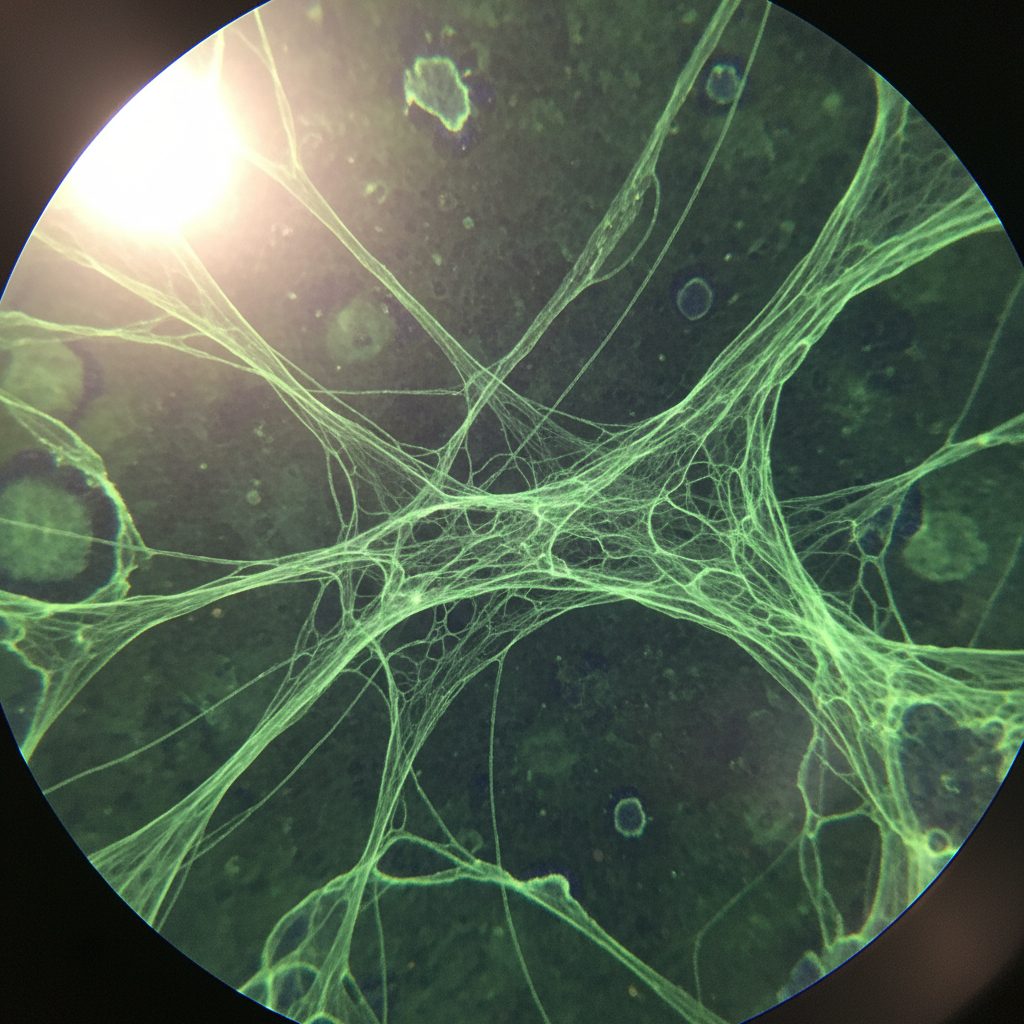
So, they essentially glued S2 peptide and EGFP together. Now, when this GST-S2-EGFP fusion protein hits cells, the S2 peptide part says “Hello, fibronectin!” It latches right onto fibronectin as it is assembling into fibrils. Because S2 peptide is carrying EGFP, the entire fibronectin fibril suddenly glows green! It is like watching a microscopic construction site light up!
This fusion protein lets researchers perform live cell imaging. They watch matrix formation and maturation in real-time. They can see “nascent fibril nucleation and elongation from coalescing FN aggregates.” In plain English? They can watch tiny piles of fibronectin molecules (the “aggregates”) slowly start to click together (that is “nucleation”). Then they grow longer and longer (that is “elongation”) into full-blown fibrils. The S2 peptide makes this time-lapse video possible, brick by brick, from the ground up!
What is even cooler is that this S2 peptide fusion protein stays stuck to fibronectin even in decellularized matrices. That means they can remove all the cells. The fluorescent S2 peptide is still there. It highlights the fibronectin network that the cells used to make. This is huge for studying the structure of the ECM without any cellular distractions. The S2 peptide preserves the matrix glow post-decellularization.
Diving deeper, the S2 peptide shines in decellularized setups. After removing cells, the ECM remains intact. The bound S2 peptide fluoresces the fibronectin mesh. This lets scientists map mature networks. They quantify fibril thickness and branching. Such data informs biomechanics models. Fibrotic tissues show altered fibrils. The S2 peptide could compare healthy vs. diseased matrices. Imagine staining patient biopsies with S2 peptide. Doctors spot fibrosis early. Treatments target specific defects. The S2 peptide thus bridges lab to clinic.
Moreover, the S2 peptide works across cell types. Fibroblasts, endothelial cells, all assemble fibronectin. The S2 peptide tracks them uniformly. This consistency boosts reproducibility. Studies confirm S2 peptide specificity. It does not bind other ECM proteins much. Low background noise means clear signals. Researchers optimize S2 peptide concentrations for best imaging. Too little misses fibrils. Too much bleaches fast. Fine-tuning maximizes insights.
Honestly, this fusion protein is like getting a brand-new, super-powered gadget for the scientific community. It represents a phenomenal new tool for real-time analysis of the ECM. We can finally watch the cellular architects at work. We see how they build and rebuild our body’s infrastructure. The S2 peptide reveals hidden dynamics.
Next, generation of fluorescent scaffolds. Imagine creating a glowing tissue scaffold in a lab. It perfectly mimics the body’s natural structure. The S2 peptide labels fibronectin in these scaffolds. This could be a game-changer for regenerative medicine. It helps us grow new tissues and organs! Engineers seed scaffolds with cells. The S2 peptide tracks integration. Success rates skyrocket.
Directing functional proteins to FN matrix comes third. Because S2 peptide sticks to fibronectin, we could potentially use it as a molecular delivery truck. Attach other functional proteins or even medicines to S2 peptide. Send them straight to specific spots in the fibronectin matrix. Think targeted drug delivery right to the source of a fibrotic problem! In fibrosis, deliver anti-scarring agents via S2 peptide. Precision beats systemic drugs.
Beyond basics, the S2 peptide sparks innovation. Cancer research benefits too. Tumors remodel ECM with fibronectin. The S2 peptide images these changes. It reveals metastasis paths. Wound healing studies use S2 peptide for faster closure. Chronic wounds often fail due to poor ECM. S2 peptide monitors repair. Developmental biology gains from embryo imaging. The S2 peptide shows tissue patterning live.
Therapeutics build on S2 peptide. Fuse it to enzymes that degrade bad fibrils. Fibrosis recedes selectively. Or link to growth factors for repair. The S2 peptide guides them home. Diagnostics evolve with S2 peptide biosensors. Detect ECM flaws early. Nanotechnology incorporates S2 peptide. Nanobots navigate via fibronectin glow.
Challenges remain, sure. The S2 peptide needs in vivo testing. Animal models first, then humans. Toxicity checks ensure safety. Scale-up for clinical use. But potential outweighs hurdles. Funding pours in for S2 peptide projects. Collaborations multiply.
This little S2 peptide is truly a gem hunter’s dream come true. It offers unprecedented insights into the dynamic world of our own biology. Who knew such tiny molecules held such massive potential? The future of understanding and treating diseases linked to the ECM just got a whole lot brighter (and greener!). The S2 peptide leads the charge.
What is your hidden peptide pearl? DM me. Let’s co-author the next unearthed epic. 🧪
All human research MUST be overseen by a medical professional.