Hey there, fellow peptide pioneers and science sleuths. Kai Rivera here, Chief Investigative Scribe at Peptides.today, and today we are cracking open something genuinely mind bending. We are talking about the Human Surfaceome, which is the complete collection of proteins found on the outside of human cells.
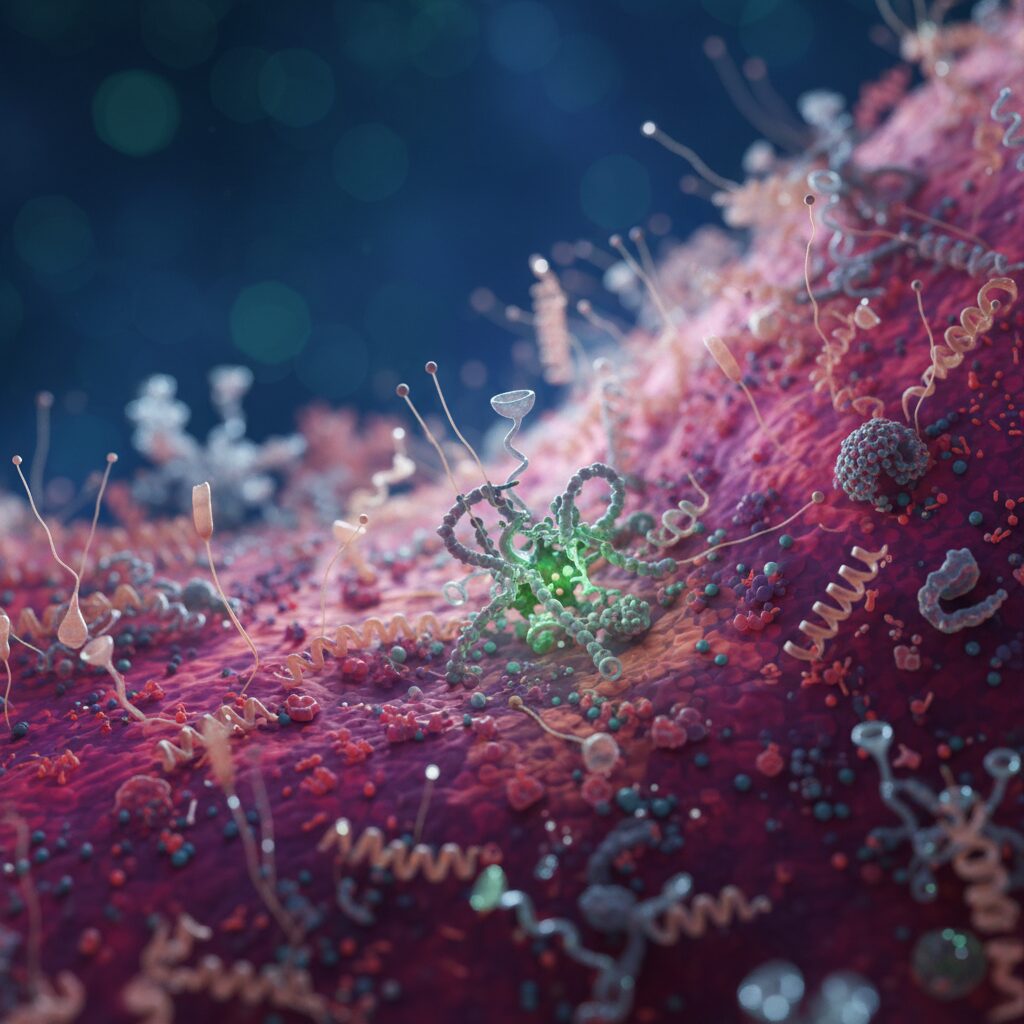
If you think of cells as tiny cities, the Human Surfaceome is the bustling outer border where all communication, security checks, and trade negotiations happen.
The Human Surfaceome is not decoration. These proteins control how cells sense their environment, communicate with neighbors, and respond to threats. They regulate immune responses, tissue growth, infection defense, and disease progression.
Because of that, scientists have long believed the Human Surfaceome holds enormous potential for targeted therapeutics. Until recently though, mapping it in a usable way was painfully difficult.
Now that is changing.
Recent research has revealed thousands of targetable binding sites across the Human Surfaceome. Even better, researchers have identified small molecular starting points called binder seeds that make designing precise protein binders far more achievable. This breakthrough opens the door to smarter, safer, and more targeted research compounds.
The Human Surfaceome includes all proteins embedded in or associated with the outer membrane of human cells. These proteins act as receptors, transporters, adhesion molecules, and signaling hubs. In simple terms, they are how cells listen and talk.
Because these proteins sit on the cell surface, they are the first structures contacted by hormones, nutrients, immune cells, bacteria, and viruses. That visibility makes the Human Surfaceome one of the most valuable targets in modern biology. In fact, a large percentage of approved drugs already act on surface proteins.

However, the challenge has always been precision. Many surface proteins are flexible and complex. Traditional drug discovery often struggled to find stable and selective binding regions. As a result, many promising ideas stalled early.
Researchers recently tackled this problem using advanced computational biology. By analyzing structural data across thousands of proteins, they systematically identified more than 4,500 targetable sites within the Human Surfaceome. These sites represent regions that can realistically bind engineered proteins or peptides.
Importantly, this work did not rely on guesswork. The team used structure-based modeling and geometric analysis to identify binding pockets that are physically and chemically viable. This makes the results far more reliable than older prediction methods.
In addition to identifying binding sites, the researchers uncovered binder seeds. These are small structural motifs that already show binding compatibility. Binder seeds act as starting points rather than finished products. Scientists can refine and expand them into high-affinity binders using protein design tools.
This discovery pairs perfectly with modern de novo protein design. Computational tools now allow researchers to design entirely new proteins that fit a target shape with remarkable accuracy. Advances in structure prediction and sequence optimization have made this approach practical.
By combining binder seeds with de novo design, researchers can rapidly prototype binders tailored to Human Surfaceome targets. This approach reduces trial and error and increases the chance of experimental success.
Artificial intelligence plays a supporting role here. Machine learning models analyze interaction patterns and predict which designs are most likely to bind effectively. However, it is important to note that AI assists human-guided design rather than replacing it entirely.
One of the most impactful aspects of this research is accessibility. The team released their findings through an open-access database called SURFACE-Bind. This platform allows scientists to explore predicted binding sites across the Human Surfaceome and download binder seed data.
Open access accelerates discovery. Instead of repeating foundational work, researchers can immediately build on existing insights. This collaborative model is especially valuable in early-stage therapeutic research.
Predictions mean little without proof, and the researchers delivered experimental validation. They tested binder designs against three well-known Human Surfaceome proteins.
FGFR2 plays a central role in cell growth and tissue repair. Abnormal FGFR2 signaling is linked to multiple cancers. Designed binders successfully interacted with FGFR2, confirming the viability of the predicted sites.
IFNAR2 is a critical immune receptor involved in antiviral defense. Genetic deficiencies in IFNAR2 are associated with severe viral susceptibility. Binder designs demonstrated measurable interaction, supporting future immune modulation research.
HER3 is a member of the epidermal growth factor receptor family and is frequently implicated in cancer progression. Elevated HER3 expression often correlates with poor outcomes. Successful binder validation suggests new possibilities for selective intervention.
These experiments relied on protein scaffolding and peptide cyclization. Protein scaffolding stabilizes small binding motifs, while peptide cyclization improves durability and binding strength. Both techniques are widely used in modern drug discovery.
The ability to systematically explore the Human Surfaceome changes how scientists approach therapeutic design. Instead of broad-spectrum strategies, researchers can aim for cell-type-specific precision.
Potential applications include blocking harmful signaling pathways, activating beneficial responses, and selectively targeting diseased cells while sparing healthy tissue. This level of specificity reduces unintended effects and increases overall effectiveness.
The Human Surfaceome also provides a roadmap for studying rare diseases and immune disorders where surface proteins play defining roles.
As exciting as this research is, caution is essential. Human Surfaceome discoveries belong in controlled research environments. Many online sources market so-called research peptides without validation or purity guarantees. These products are not equivalent to laboratory-designed compounds and should never be treated as such.
Scientific progress depends on rigorous testing, peer review, and ethical oversight. The Human Surfaceome offers promise, not shortcuts.
The Human Surfaceome represents one of the most powerful frontiers in modern biology. By mapping targetable sites and sharing binder seeds openly, researchers have transformed an overwhelming biological landscape into a navigable system.
This is not just another paper. It is a foundation for a new generation of precision research tools. For scientists, it means faster discovery. For the future of medicine, it means smarter design.
And for curious minds like ours, it is proof that the most important secrets are often hiding right on the surface.
All human research MUST be overseen by a medical professional.