Hey, peptide pals and cosmic connoisseurs! Kai Rivera here, Chief Investigative Scribe, coming at you with wild news. We are diving into the world of prebiotic chemistry in space to see how life starts. Ever wonder if life’s basic ingredients could just poof appear out there?
I am talking about amino acids linking up to form peptides right in the cold vacuum. It sounds like science fiction, but researchers are teasing out mind-bending possibilities. Space acts like a giant, radiation-powered chemical factory for molecular LEGOs.
The big question is how these bioorganic molecules even got started in the void. We know they are scattered across the galaxy like glitter thanks to meteorites. However, simply having the pieces is not enough because you need a way to build.
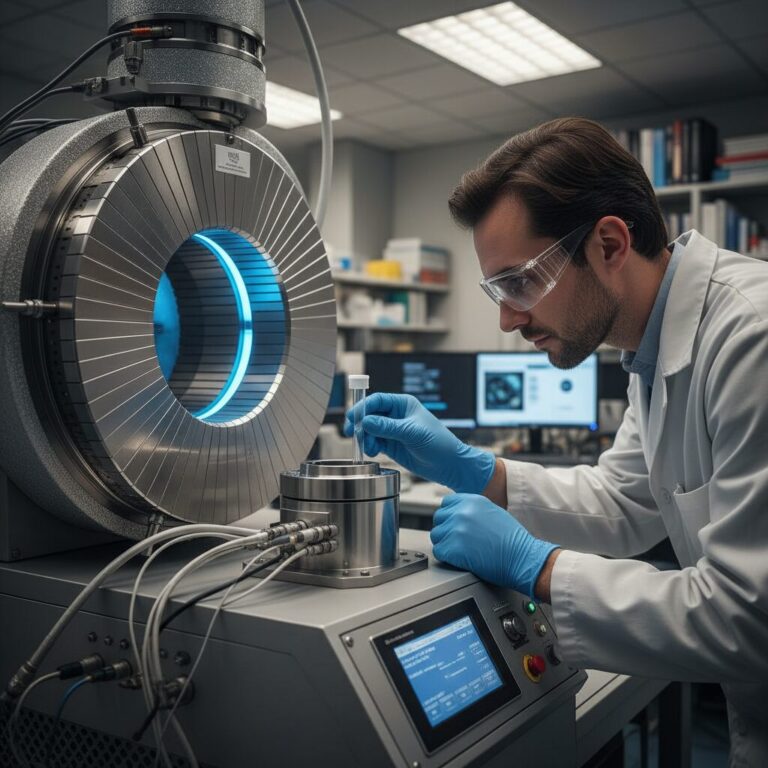
Prebiotic chemistry in space relies on ionizing radiation as a powerful catalyst for change. This is not your grandma’s microwave but high-energy particles hitting atoms. These energetic zaps act like molecular matchmakers to kickstart reactions.
Experiments on the Chinese Space Station show that low-dose radiation builds dipeptides. Persistent radiation acts as a steady energy source for abiotic synthesis over many months. This energy helps assemble the complex foundations of our genetic material.
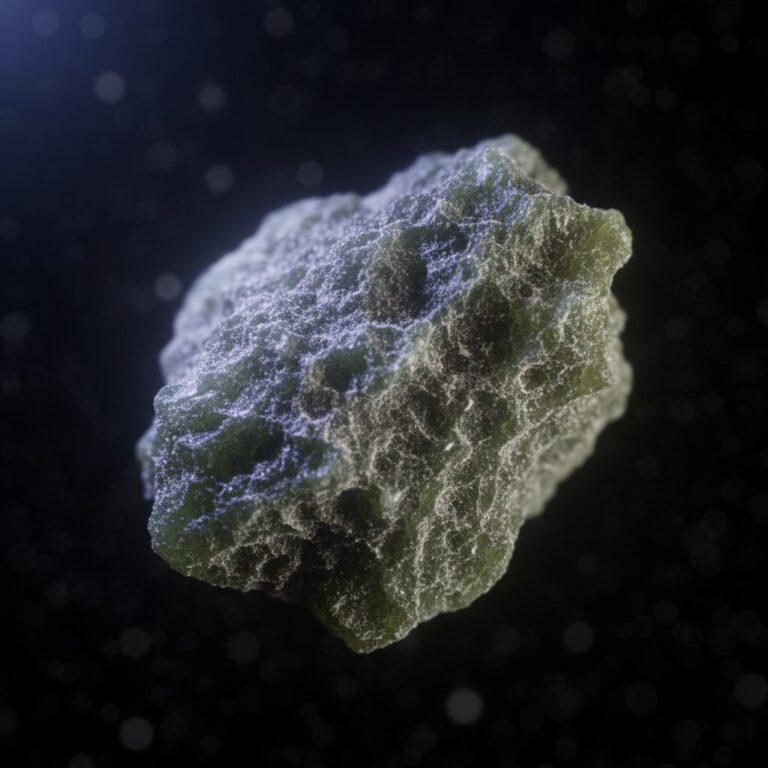
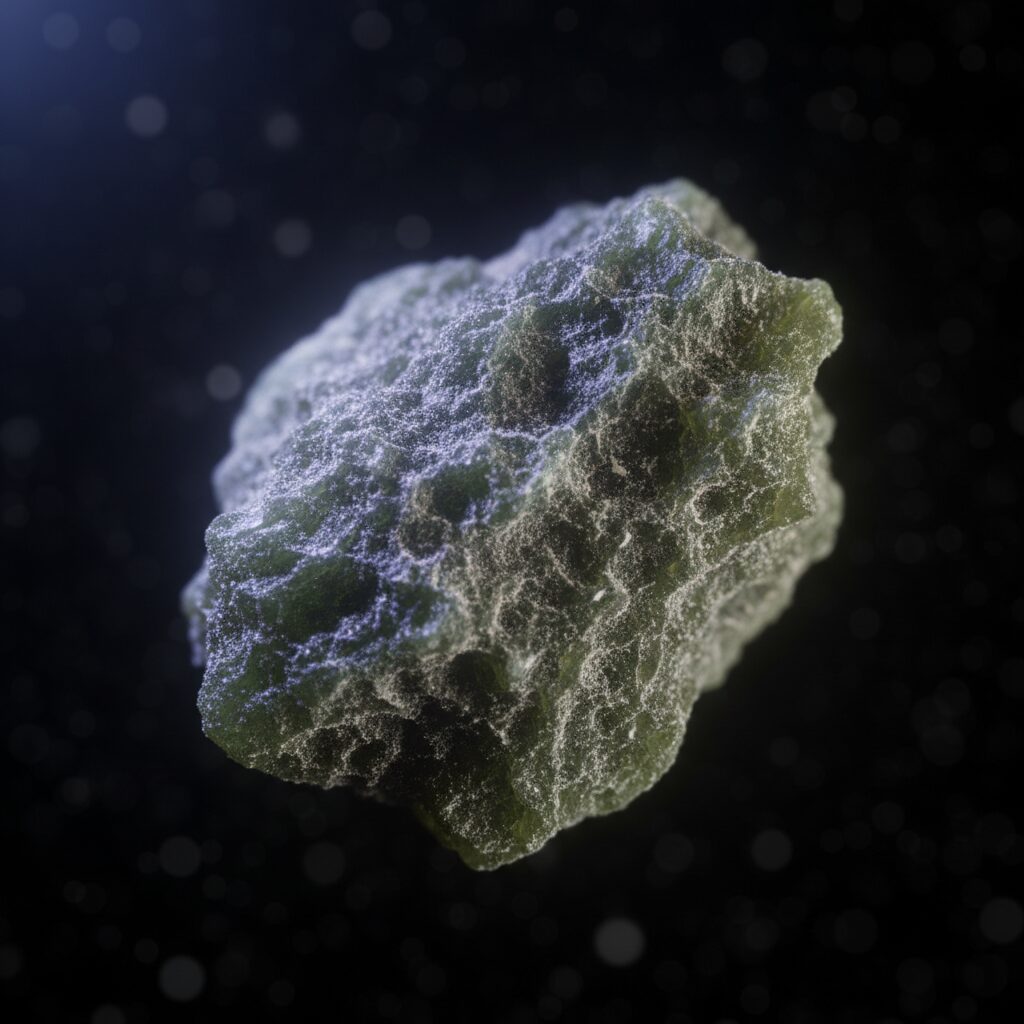
You might know olivine as a greenish mineral found in many volcanic rocks. Its magnesium-rich cousin, forsterite, is a major player in prebiotic chemistry in space. It acts as a radiation-resistant platform where chemical dance parties happen.
Forsterite surfaces are dotted with Lewis bases and acids that attract molecules. These sites act like tiny magnets to hold amino acids and phosphates. This concentration makes it much more likely for the reactants to interact.
The mineral also creates a localized alkaline environment with a specific pH level. This creates a goldilocks zone for forming the bonds that stitch proteins together. Magnesium ions in the mineral are vital components for this cosmic orchestra.

Phosphorus is key for anyone trying to piece together a genetic nucleotide. On early Earth, most phosphorus was locked up in insoluble minerals like apatite. This created the famous phosphate problem that stalled many scientific theories.
Prebiotic chemistry in space finds a solution using sodium trimetaphosphate or P3m. This cyclic polyphosphate is a soluble source activated by cosmic ionizing radiation. It acts as a pre-packaged energy bar for building genetic material.
Recent discoveries from Saturn’s moon Enceladus show phosphates are widespread in the cosmos. This makes the role of P3m even more compelling for extraterrestrial origins. These reactive compounds facilitate both peptide and nucleotide synthesis in harsh environments.
Phosphorus is key for anyone trying to piece together a genetic nucleotide. On early Earth, most phosphorus was locked up in insoluble minerals like apatite. This created the famous phosphate problem that stalled many scientific theories.
Prebiotic chemistry in space finds a solution using sodium trimetaphosphate or P3m. This cyclic polyphosphate is a soluble source activated by cosmic ionizing radiation. It acts as a pre-packaged energy bar for building genetic material.
Recent discoveries from Saturn’s moon Enceladus show phosphates are widespread in the cosmos. This makes the role of P3m even more compelling for extraterrestrial origins. These reactive compounds facilitate both peptide and nucleotide synthesis in harsh environments.
These findings suggest that complex biomolecules do not only arrive They also assemble right there in situ on radiation-resistant mineral surfaces. The universe is actively contributing to the genesis of life.
The stability of these research compounds is vital for long-term survival. For example, the Phe-Phe dipeptide shows remarkable stability under cosmic radiation levels. A delicate balance exists where radiation activates reactions without destroying the results.
We are shifting how we think about where and how life originates. Earth is not the only unique crucible for creation in the vast universe. The hunt for life beyond our planet just got much more rock and roll.
What’s your hidden peptide pearl? DM me—let’s co-author the next unearthed epic. 🧪
¹ Ding, R., Qiu, S., Guo, X. et al. Space ionizing radiation triggers the formation of peptides and organophosphates on olivine surfaces. Nat Commun (2026). (Article in Press – Forthcoming Publication)
² Krasnokutski, S. A., Chuang, K. J., Jäger, C., Ueberschaar, N., & Henning, T. (2022). A pathway to peptides in space through the condensation of atomic carbon. Nature Astronomy, 6(4), 381–386. https://doi.org/10.1038/s41550-022-01625-x
³ Gan, D., Ying, J., & Zhao, Y. (2022). Prebiotic Chemistry: The Role of Trimetaphosphate in Prebiotic Chemical Evolution. Frontiers in Chemistry, 10, 941228. https://doi.org/10.3389/fchem.2022.941228
⁴ Postberg, F., Altobelli, N., Klenner, F., Morlok, A., Hillier, J. K., Khawaja, N., … & Srama, R. (2023). Detection of phosphates originating from Enceladus’s ocean. Nature, 618(7964), 489–493. https://www.nature.com/articles/s41586-023-05987-9
All human research MUST be overseen by a medical professional