Hey, my fellow peptide prospectors and bio-buddies! Kai Rivera here, Chief Investigative Scribe at Peptides.today, ready to blast off into another mind-bending scientific adventure. Today, we’re talking about something so cool, it’s like finding a hidden level in your favorite retro game: predicting how our amazing immune system reacts to stuff. Specifically, we’re diving deep into a new deep-learning model called ImmunoStruct.
Ever wonder how vaccines work? Or how our body figures out what’s an enemy invader (like a nasty virus) and what’s just, you know, a harmless bagel? It’s all thanks to tiny little molecular conversations happening constantly.
Our immune system has these special “scouts” called T-cells. They’re like the bouncers at the VIP club of our bodies. But how do they know who to let in and who to kick out? They look for special ID badges, these little protein bits called “epitopes,” presented by other cells on something called the Major Histocompatibility Complex (MHC).
It’s like a microscopic show-and-tell, and if the T-cell bouncer recognizes the epitope as “bad news,” then BAM! Immune response engaged!
The big challenge? Finding those crucial “bad news” epitopes for vaccines or cancer treatments has been like trying to find a needle in a haystack – blindfolded, in the dark, during a tornado. Traditional methods mostly looked at the simple “spelling” of these epitopes (their amino acid sequence). But that’s like judging a book only by its cover.
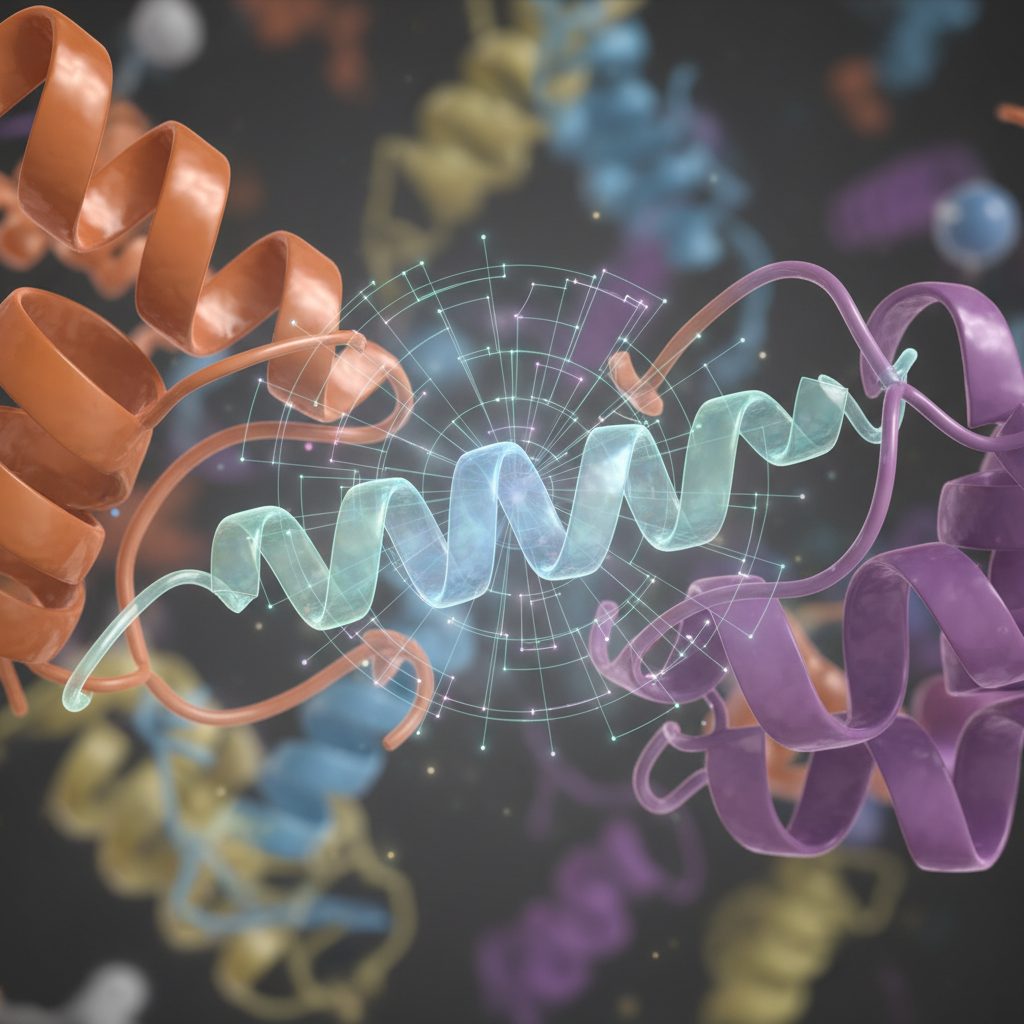
There’s so much more to the story! That’s where ImmunoStruct waltzes in, all swagger and data-driven brilliance. It’s a new deep learning model that doesn’t just look at the spelling; it looks at the whole picture – the sequence, the 3D shape, and even the tiny chemical quirks.
Basically, ImmunoStruct is giving our bouncers X-ray vision and a super-spy dossier on every single ID badge. The goal? To predict which epitopes will really get the immune system fired up, so we can make super-effective vaccines and smarter cancer therapies. How cool is that?!
Okay, tangent time: ready to dive into the nitty-gritty? Let’s dig deeper into how ImmunoStruct pulls off this biochemical magic trick!
So, remember those T-cell bouncers and their VIP club? The “ID badges” they check are actually small pieces of proteins, called peptides, displayed on specialized molecules called Major Histocompatibility Complex (MHC) molecules.
Think of MHC molecules as tiny serving platters on the surface of almost every cell in your body. When a cell gets infected, or if it’s a cancer cell going rogue, it chops up some of its own proteins (or the invading virus’s proteins) into these small peptide pieces. Then, it loads these peptides onto the MHC platters and displays them on its surface. It’s basically saying, “Hey, T-cells! Look what I found!”
There are two main types of MHC molecules, Class I and Class II, and they each have their own specific jobs. MHC Class I molecules usually show off peptides from inside the cell, often alerting cytotoxic (killer) T-cells to internal problems, like viral infections or cancer.
MHC Class II molecules, on the other hand, usually display peptides from outside the cell, gathered by immune cells that have “eaten” an invader. These signal helper T-cells to coordinate a broader immune attack. It’s a super sophisticated system, right?
Getting these interactions right is absolutely foundational for our immune system to function properly, and it’s super important when we’re trying to design vaccines that actually work or therapies that target cancer cells specifically ¹.

For decades, scientists have been trying to predict which peptides will bind to which MHC molecules, and even more importantly, which of those binding peptides will actually trigger an immune response that’s immunogenicity.
Because, let’s be real, you can have a peptide binding like crazy, but if it doesn’t get the T-cells to do anything, it’s just a pretty protein bit doing nothing. It’s like having a key that fits the lock but doesn’t actually turn the bolt!
Here’s where ImmunoStruct totally flips the script. Older methods for predicting immunogenicity were a bit like trying to understand a complex novel by only reading a list of words in it. They mostly focused on the amino acid sequence of the peptide – basically, the “spelling” of the protein fragment.
But guess what? Proteins aren’t flat words on a page! They’re intricate 3D structures that fold and wiggle, and their shape absolutely dictates how they interact with other molecules, including those MHC platters.
ImmunoStruct is a deep learning model that says, “Why look at one piece of the puzzle when you can look at all of them?” It’s like having a super-sleuth detective who considers not just the suspect’s name, but also their height, their gait, their fingerprints, and even what they had for breakfast. ImmunoStruct blends three crucial types of information, making it a true multimodal marvel:
By throwing all this data into its super-smart deep learning brain, ImmunoStruct learns patterns and relationships that were practically invisible to older, simpler methods. It was trained on a gigantic dataset of 26,049 real-world peptide–MHC interactions, which is like giving a student every textbook ever written and then letting them ace the exam ¹.
This huge training set allows the model to become incredibly good at its job, outperforming previous prediction methods that only focused on sequence data. It’s truly next-level prediction, baby!
Now, for a quick brain flex into the “how” of ImmunoStruct’s genius. This model uses something pretty fancy called “equivariant graph processing techniques.” Don’t let the big words scare you! Imagine each amino acid in a peptide as a little dot, and the connections between them as lines.
That’s a “graph.” Equivariant means that if you twist or turn that peptide in 3D space, the model still understands it’s the same peptide, just from a different angle.
Why is this important? Because the immune system recognizes peptides in 3D! If a traditional model only looks at a flat sequence, it might miss crucial clues that come from how the peptide folds and interacts spatially with the MHC.
Equivariant graph processing allows ImmunoStruct to literally “see” and understand the peptide and MHC in 3D, keeping all that important spatial information intact. It’s like having a sculptor analyze a statue, rather than just reading a list of the materials used.
This means it’s capturing the relationships between amino acids not just in a line, but in a full, three-dimensional dance. This holistic perspective is key for spotting those truly immunogenic candidates, and honestly, it’s a big reason why ImmunoStruct is such a gem!
One of the coolest things about ImmunoStruct isn’t just what it predicts, but why it predicts it. In the high-stakes world of therapeutic development, knowing why something works (or doesn’t) is like having a cheat sheet for the universe.
ImmunoStruct offers “interpretability,” meaning it can give insights into why certain peptides are immune system rockstars while others are total duds.
This ability to peek behind the curtain is HUGE. Imagine you’re designing a new vaccine. Instead of just getting a “yes” or “no” answer on whether a peptide will work, ImmunoStruct can help you understand which specific parts of the peptide or its interaction with the MHC are making it immunogenic.
This can dramatically speed up vaccine design, helping researchers tweak and refine potential therapies much faster, saving precious time and resources. It’s like having a detailed map, not just a destination pin on a GPS!
ImmunoStruct isn’t just a lab curiosity; it’s already showing serious muscle in real-world scenarios. Remember the mad dash for COVID-19 vaccines? Scientists had to quickly identify parts of the SARS-CoV-2 virus that would trigger a strong immune response.
When ImmunoStruct was put to the test with SARS-CoV-2 epitopes, its predictions lined up perfectly with actual lab results, like a perfectly synced TikTok dance ¹. This means the model could be a superpower for quickly developing vaccines against new, emerging infectious diseases – a literal lifesaver when the next global health challenge inevitably pops up.
But wait, there’s more! ImmunoStruct is also showing promise in the ongoing battle against cancer. Cancer cells often have tiny, unique protein snippets called “neoepitopes” that arise from their mutations. These neoepitopes are like secret passwords that only T-cells can recognize as “enemy!” If we can accurately predict which neoepitopes will rally the immune system, we can design super-personalized cancer vaccines.
These vaccines would teach a patient’s own immune system to hunt down and destroy their specific cancer cells, leaving healthy cells alone ². ImmunoStruct has actually shown it can predict survival outcomes for cancer patients based on these peptide–MHC interactions ¹.
This could be a total game-changer for personalized medicine, guiding doctors to the most effective treatments for each individual patient. It’s like having a custom-built, laser-guided missile for your own cancer!
The rise of ImmunoStruct is more than just one cool model; it’s a signpost for the future of biology and medicine. Deep learning and artificial intelligence are becoming indispensable tools, changing how researchers analyze complex biological data and make predictions ³. ImmunoStruct, with its ability to integrate different types of data, is a shining example of this AI-powered revolution.
As we continue our relentless quest against infectious diseases and cancer, tools like ImmunoStruct are no longer just “nice to have” – they’re becoming absolutely vital. The more accurately we can predict immunogenicity, the faster we can develop groundbreaking vaccines and therapies.
Imagine a world where we can quickly design a vaccine for a new pandemic threat or create a personalized cancer treatment with unprecedented precision. That’s the world ImmunoStruct is helping us build, one data point at a time.
The journey to fully unlock its potential is just beginning, with researchers already eyeing even larger datasets and more refined models ¹. It’s an exciting time to be alive, my friends!
What’s your hidden peptide pearl? DM me—let’s co-author the next unearthed epic. 🧪
All human research MUST be overseen by a medical professional.