Alright, fellow peptide pirates and molecular explorers! Kai Rivera here, your Chief Investigative Scribe, back from another deep dive into the awesome, often bewildering world of tiny biological powerhouses. Today, we’re talking about something super cool, a scientific magic trick that’s helping us build new, super-smart Graspeptides molecules.
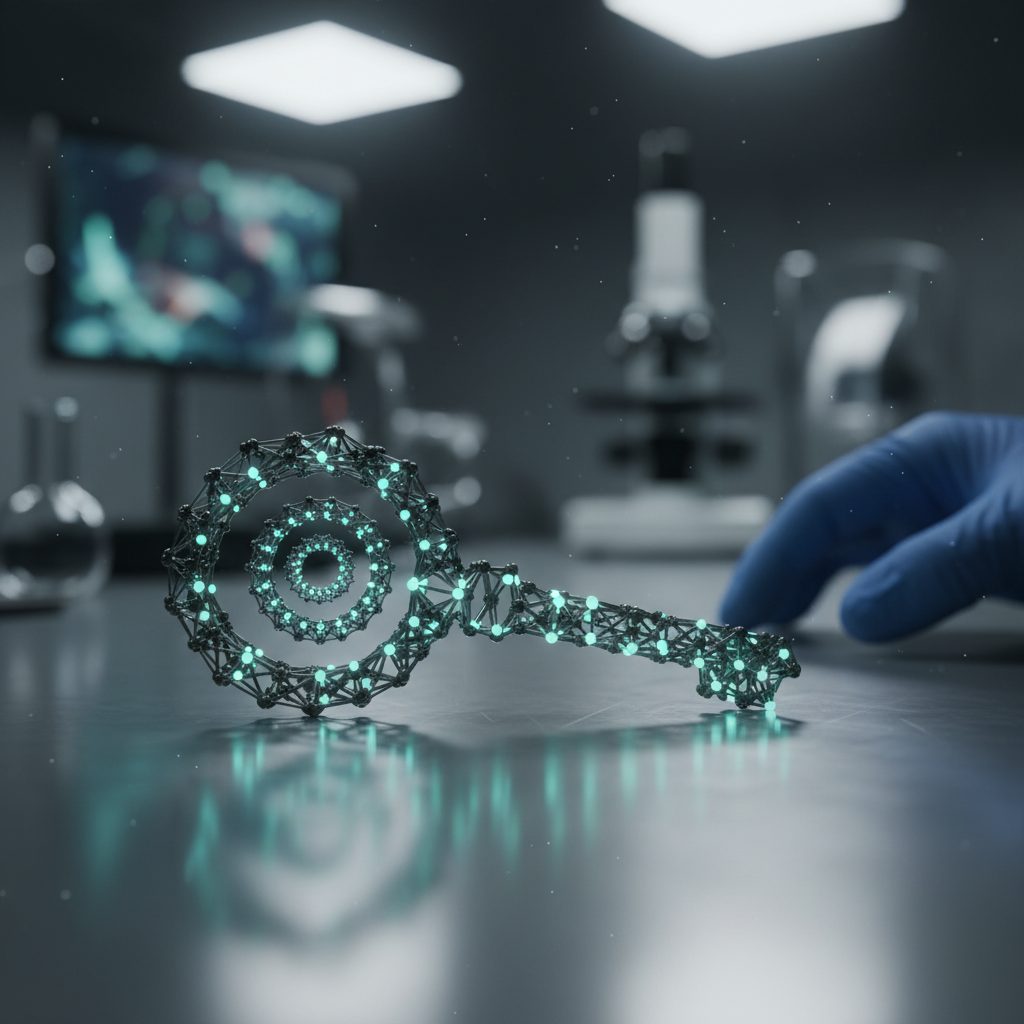
Imagine you’ve got a super-secret safe, right? And you need a very specific key to open it. But not just any key, a key that can bend, twist, and maybe even have a secret extra loop! Well, scientists just figured out a wild way to make those kinds of “keys” way more easily, opening up a whole new world of possibilities for medicine and understanding our bodies better.
We’re talking about making special kinds of “graspeptide mimetics” using a clever enzyme, and it’s a total game-changer for finding molecules that can actually target tricky proteins like TEAD4. This is like building a bespoke, super-flexible skeleton key for some of the toughest locks out there, and trust me, it’s way more exciting than watching paint dry!
Okay, tangent time: ready to dive into the nitty-gritty? Let’s dig deeper into how these molecular locksmiths are shaking things up!
First things first: what’s a graspeptides, anyway? Think of peptides as tiny chains of amino acids, like LEGO bricks linked together. Our bodies are swimming with them, doing all sorts of crucial jobs. Now, graspetides are a special, super-cool group of these peptides.
They’re what scientists call “ribosomally synthesized and post-translationally modified peptides” (try saying that five times fast!). Basically, they start as regular peptides, but then they get awesome makeovers, often with special “ester” or “amide” connections on their side chains¹.
Imagine your LEGO chain suddenly getting some extra fancy, super-strong clips connecting the bricks in unexpected ways, making the whole structure extra stable or giving it a unique shape.
But here’s the kicker: making different kinds of these cool, modified peptides, especially ones with unique ring-like shapes, has been like trying to herd cats while juggling flaming torches. Super difficult! That’s where “graspeptides mimetics” come in.
These aren’t the original graspetides, but rather super-clever copies or inspired versions. They’re like the best fan art, but instead of drawings, they’re molecules designed to mimic the important actions of the originals, sometimes even doing them better!
This whole study is about finding new, easier ways to build a massive library of these powerful mimetic molecules.
So, how do you build these complex, ring-shaped peptide copies? Well, our brilliant scientists are using a trick that sounds straight out of a sci-fi movie: an enzyme called sortase. Now, if you’ve ever played with LEGOs, you know how satisfying it is to snap two bricks together, right?
Sortase is kind of like a super-precise LEGO master builder, but for peptides. Its job? To form peptide bonds, which are the links that hold amino acids together. It’s like a tiny, biochemical sewing machine that can stitch two different protein pieces together². Pretty neat, huh?
Here’s the mind-blowing part: sortase usually looks for a specific sequence of amino acids to do its work, kind of like a secret handshake. This sequence is called “LPXTG” (don’t worry too much about what the letters stand for, just know it’s a code!).
The “X” in that code? It’s usually a regular amino acid. But these brainy researchers discovered something amazing: sortase is totally chill with an ester group hanging out at that “X” position. An ester group is a different kind of chemical bond, and usually, enzymes are super picky.
This compatibility is like finding out your favorite superhero can also suddenly fly a spaceship it opens up a whole new universe of possibilities for what they can do! This little discovery is the secret sauce that lets them create these unique “graspeptides mimetics.”
Okay, get ready for a word that sounds like it belongs in a secret wizard’s spellbook: “depsipeptide.” What in the name of molecular mayhem is that? Well, remember how peptides are chains of amino acids linked by “amide” bonds?
Think of an amide bond like a standard LEGO connection. A depsipeptide is basically a peptide where one or more of those normal amide links gets swapped out for an ester link³. It’s like replacing a regular LEGO stud with a special Technic pin it changes how the whole structure can move and connect.
And why do we care about these depsipeptides? Because they can do some seriously cool things that regular peptides can’t, often leading to more stable molecules or ones that can get into cells more easily. The researchers in this study didn’t just make one kind of depsipeptide; oh no, they went wild!
They cooked up six different types of graspeptides mimetics. This included “monocyclic” depsipeptides (think of a single, elegant ring, like a wedding band) and “bicyclic” depsipeptides (now we’re talking two interconnected rings, like a fancy puzzle ring!).
These different shapes, or “topologies” as the science folks say, are super important because a molecule’s shape dictates what it can do and what it can stick to. It’s like having a whole toolbox of differently shaped keys for differently shaped locks.
So, you’ve made a bazillion different cool, ring-shaped depsipeptides. How do you figure out which one actually works? That’s where “phage display” comes in, and it’s seriously ingenious. Imagine you have a library with millions of books, but each “book” has a different peptide on its cover.
And you’re looking for one specific book that can bind perfectly to a certain “reader” (which is your target protein). Trying to find that one book would be impossible, right?
Phage display uses tiny viruses called bacteriophages (don’t worry, these only infect bacteria, not us!) to “display” peptides on their outer coat⁴. So, each virus particle becomes a tiny, peptide-coated billboard. The scientists create millions of these different phage-peptide combinations, essentially building a massive library of potential “keys.”
Then, they “fish” for the ones that stick to their target protein (our “lock”). The phages that bind strongest are the ones carrying the best-fitting peptides. It’s like a super-fast, super-efficient natural selection process for finding the perfect molecular match!

Using this incredibly powerful method, the researchers found a specific bicyclic depsipeptide. Remember those fancy double-ringed ones? This particular one was a rockstar, perfectly targeting a protein called TEAD4. And get this: it had a “KD value” of 2.2 µM.
Without getting too bogged down in the numbers, a lower KD value means the peptide binds more strongly to its target. So, 2.2 µM tells us this bicyclic depsipeptide is a pretty good “key” for the TEAD4 “lock!”
Alright, let’s talk about the “lock” this awesome bicyclic depsipeptide found: TEAD4. Sounds like a robot’s name, right? But TEAD4 is a protein inside our cells, and it plays a seriously important role. It’s part of something called the Hippo pathway (no, not actual hippos, but another cool biological system!), and it’s a major player in cell growth, how cells survive, and even how tissues regenerate and stem cells work⁵.
Now, usually, these jobs are super helpful and keep us healthy. But sometimes, especially in diseases like cancer, things go sideways. When TEAD4 gets a bit too enthusiastic, it can cause cells to grow and divide way too much, which is exactly what happens in tumors.
So, finding a molecule that can specifically target and maybe even block TEAD4? That’s a huge deal. It could potentially lead to entirely new ways to fight cancer and other diseases where cell growth is out of control. Imagine a world where we could whisper to rogue cells, “Hey, TEAD4, chill out!” This depsipeptide is a step toward that whispered command.
What this whole amazing dance of enzymes and peptides boils down to is a new, super-flexible way to build “cyclic peptide libraries.” Think of “peptiligase-based systems” as the ultimate custom LEGO factory for peptides.
Before this, building these complex, ring-shaped peptides with unique twists and turns was like trying to sculpt a masterpiece with dull tools. But this new “chemoenzymatic strategy” (fancy talk for using both chemistry and enzymes) is like getting a brand-new, super-sharp set of chisels.
The fact that they could generate six different types of graspeptides mimetics, including both monocyclic and bicyclic depsipeptides, and then find one that targets a difficult protein like TEAD4, is proof that this system is a powerhouse. It means scientists can now create a much wider variety of these ring-shaped peptides with “unique topologies” (remember, different shapes and structures).
This opens up a massive playground for drug discovery. More unique shapes mean more chances to find the perfect molecular “key” for all sorts of biological “locks” from cancer proteins to infectious agents. It’s like expanding your one-room cabin into a sprawling mansion of molecular possibilities!
This study isn’t just a cool experiment; it’s a beacon of hope, showing us how we can construct massive libraries of cyclic peptides, giving us an incredible toolkit to hunt for new medicines and deeply understand our biological universe. It’s a testament to the fact that when we get creative with chemistry and biology, the sky’s not even the limit it’s just the beginning of the next wild adventure!
What’s your hidden peptide pearl? DM me let’s co-author the next unearthed epic. 🧪
All human research MUST be overseen by a medical professional