
Hey there, fellow science fanatics and curious minds. It’s your Chief Investigative Scribe, Kai Rivera, back again to decode another microscopic mystery. Today, we are diving straight into bicyclic peptides, one of the most exciting molecular tools emerging in modern drug discovery.
Bicyclic peptides are tiny chains of amino acids designed to interact with very specific cellular targets. However, designing them to hit only the right target is not easy. Researchers often struggle with selectivity.
A molecule meant to bind one protein may accidentally bind several others. As a result, treatments lose precision and gain side effects. This challenge is especially serious when the target is a family of closely related proteins like integrins.
So, what exactly are bicyclic peptides. In simple terms, they are short peptides that are chemically locked into two interconnected loops. Because of this structure, bicyclic peptides hold a rigid three dimensional shape. That rigidity makes them far more stable and predictable than linear peptides.
More importantly, bicyclic peptides can grip their targets with exceptional precision. Their constrained shape allows them to fit protein surfaces like a custom molded glove. As a result, they are less likely to flop around and bind unintended targets. This makes them extremely valuable in drug development, especially for complex biological systems.

Integrins are proteins found on the surface of cells. They act like sensors and anchors at the same time. Through integrins, cells attach to their surroundings, communicate with nearby cells, and respond to environmental signals.
However, not all integrins behave nicely. Some integrins become overactive during disease. One notable example is integrin αvβ3. This integrin appears at high levels in tumor blood vessels and certain cancer cells. It plays a role in angiogenesis, tumor growth, and metastasis.
Because of this, researchers see integrins as high value drug targets. Yet targeting them is difficult. Many integrins recognize the same binding signals, which increases the risk of off target interactions. This is where bicyclic peptides begin to shine.
Many integrins bind to a short amino acid motif known as RGD. While this motif is useful, it is also common. On its own, RGD lacks selectivity. Therefore, scientists needed a way to make RGD containing molecules far more precise.
Bicyclic peptides solve this problem by controlling shape. By locking the RGD motif into a highly specific conformation, researchers can force the peptide to bind only one integrin subtype. This structural control significantly reduces unwanted interactions with other integrins.
One breakthrough involved the use of a tryptathionine bridge. This chemical feature acts like a second lock that reinforces the peptide’s shape. When applied correctly, it allows bicyclic peptides to discriminate between integrins that otherwise look nearly identical.
A standout example is peptide 5j. This bicyclic peptide was designed to selectively bind integrin αvβ3. Thanks to its rigid structure and tryptathionine bridge, peptide 5j demonstrates remarkable selectivity in experimental studies.
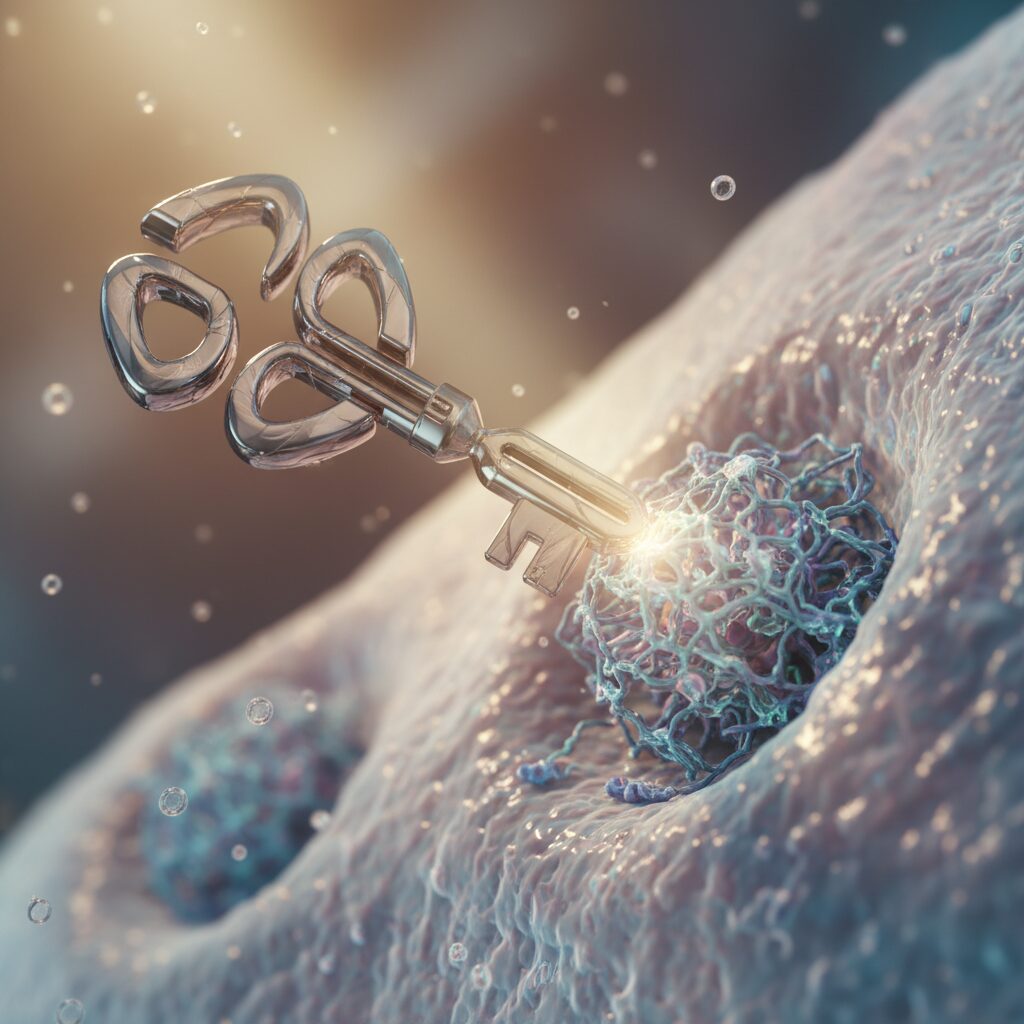
Instead of behaving like a universal key, peptide 5j functions like a custom cut key. It fits αvβ3 tightly while ignoring other integrins. This level of selectivity is rare and extremely valuable. It reduces off target effects and increases therapeutic potential.
Importantly, these findings are based on laboratory and preclinical research. While promising, peptide 5j remains a research compound and not an approved drug.
Beyond binding, bicyclic peptides can also act as delivery drivers. Once a peptide binds its integrin target, the cell may pull the entire complex inside. This process opens the door for targeted drug delivery.
By attaching a cytotoxic drug to a bicyclic peptide, researchers can create a peptide drug conjugate. The peptide guides the drug to cells expressing the target integrin. As a result, the drug concentrates where it is needed most.
This strategy may allow lower drug doses and fewer systemic side effects. In cancer research, this approach represents a major step toward precision medicine. Instead of attacking the whole body, treatment focuses on specific diseased cells.
Another advantage of bicyclic peptides is stability. Their locked structure makes them more resistant to enzymatic breakdown. This means they can survive longer in biological environments.
Additionally, their predictable shape improves reproducibility. Drug developers can fine tune binding behavior with greater confidence. Over time, this reliability reduces development risk and accelerates optimization.
Because of these properties, bicyclic peptides are being explored not only in oncology but also in inflammation, fibrosis, and immune related disorders.
Despite the excitement, it is critical to stay grounded. Most bicyclic peptides discussed in the literature are still in early research stages. They have not undergone full clinical testing.
For this reason, unregulated online sales of research peptides should be treated with caution. Purity, dosage, and safety cannot be guaranteed. Any compound intended for human use must be evaluated through regulated clinical trials and overseen by medical professionals.
Bicyclic peptides represent a powerful fusion of chemistry and biology. By mastering molecular shape, researchers are learning how to control biological interactions with unprecedented accuracy.
As design techniques improve, we can expect bicyclic peptides to play a growing role in targeted therapies. Their ability to combine selectivity, stability, and delivery makes them ideal candidates for next generation drugs.
In short, bicyclic peptides are not just another scientific trend. They are a foundational tool shaping the future of precision medicine, one carefully crafted molecular loop at a time.
What’s your favorite hidden molecule story. DM me and let’s uncover the next microscopic epic together. 🧪
All human research MUST be overseen by a medical professional.