
You know that moment when you are standing in the skincare aisle, holding a bottle and wondering if it is actually doing anything for your skin? We have all been there. The beauty world is loud, crowded, and full of promises. That is exactly why peptides in skincare have become such a hot topic.
They sound scientific, a little mysterious, and very convincing. But what do they actually do, and why is everyone suddenly talking about them?
Peptides in skincare are not just another trend with a fancy name. They are part of how your skin naturally communicates and repairs itself. Once you understand how they work, skincare starts to feel less like guesswork and more like smart decision-making.
So let us break it down together, one tiny messenger at a time.
At their core, peptides are short chains of amino acids. Amino acids are the building blocks of proteins like collagen, elastin, and keratin. If a protein is a long necklace, a peptide is a small section of that necklace.
Your body already produces peptides on its own. They act as messengers that tell cells what to do. In skincare, peptides are used to send signals to skin cells, encouraging them to behave in more youthful and balanced ways.
When peptides in skincare are applied topically, they are designed to support natural skin processes that tend to slow down with age. That includes collagen production, skin repair, and maintaining firmness.
As we get older, our skin becomes a little quieter. Collagen production slows. Repair takes longer. Elasticity is harder to maintain. This is where peptides in skincare step in.
Think of peptides as gentle reminders. They do not force your skin to change. Instead, they encourage your skin to remember what it already knows how to do.
Because of this, peptides are especially popular in anti-aging skincare routines. They work gradually and supportively rather than aggressively.

Not all peptides are the same. In fact, peptides in skincare fall into several categories, each with a different role.
These are the most common peptides in skincare. They send signals to skin cells that support collagen, elastin, and other structural components. Over time, this can help skin look firmer and smoother.
Carrier peptides help deliver trace elements, such as copper, to the skin. Copper peptides are studied for their role in skin repair and calming visible inflammation. They act like tiny delivery systems that bring helpful materials where they are needed.
Some enzymes naturally break down collagen in the skin. Enzyme-inhibiting peptides help slow that process. This supports the skin’s existing structure and helps maintain resilience.
These peptides work on expression lines. They help reduce the appearance of wrinkles by gently limiting muscle movement at the surface level. Their effect is mild and temporary, but with consistent use, skin can appear smoother.
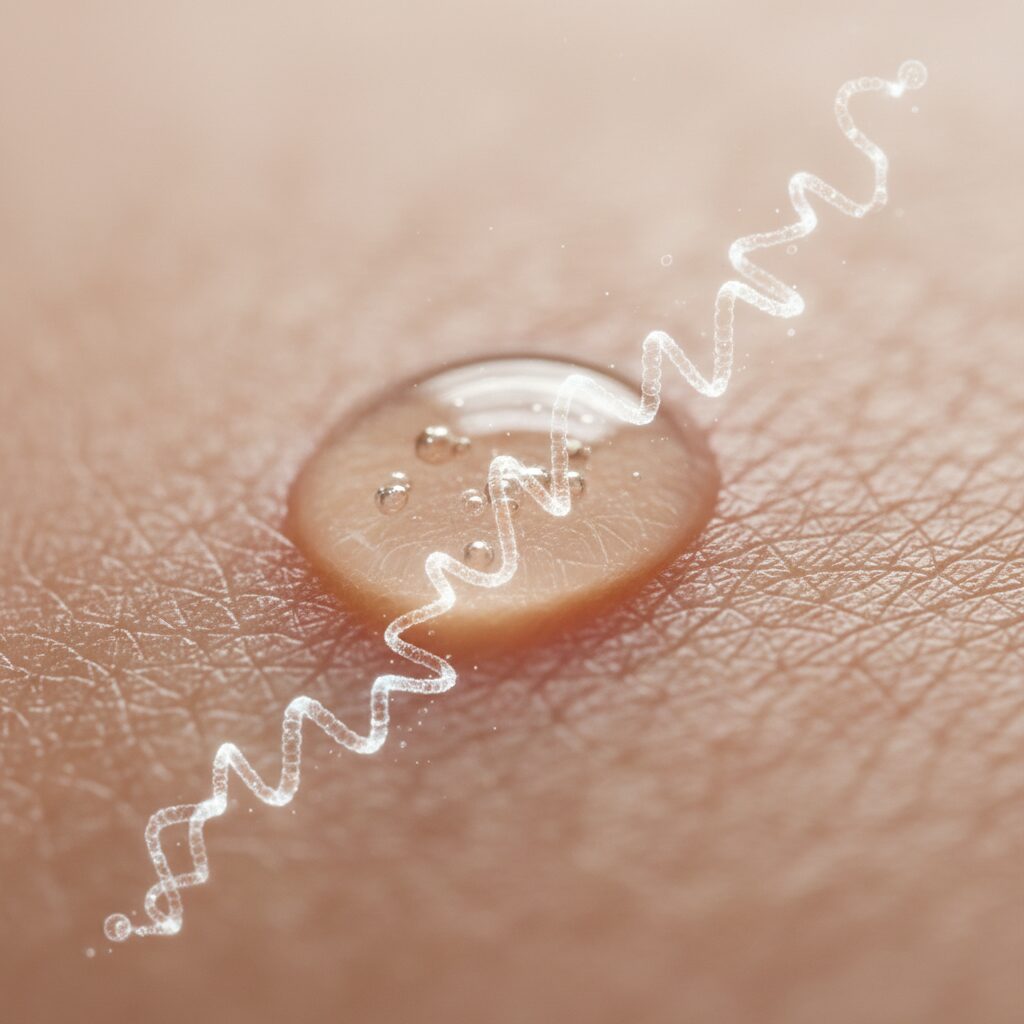
When you apply a serum or moisturizer containing peptides in skincare, those peptides sit on the skin and begin interacting with the upper layers. With proper formulation, they can reach receptors on skin cells.
Once a peptide binds to a receptor, it triggers a response inside the cell. That response depends on the peptide’s structure and purpose. Some encourage collagen production. Others support repair or calm irritation.
Results are not instant. Instead, changes appear gradually as the skin responds to repeated signals. This is why consistency matters so much with peptide-based products.
It is tempting to believe that one ingredient can fix everything. However, peptides in skincare work best as part of a complete routine.
They perform better when combined with ingredients like antioxidants, ceramides, sunscreen, and gentle exfoliants. Additionally, formulation quality plays a huge role. A well-formulated peptide product will always outperform a poorly designed one, even if the ingredient list looks impressive.
Therefore, patience and consistency are key. Most people notice visible improvements after six to eight weeks of regular use.
One of the most fascinating developments in peptides in skincare comes from bio-inspired research. Scientists are studying peptides found in nature and then recreating them in labs.
For example, researchers have investigated peptides inspired by compounds found in the Australian masked bee. These peptides are still under early-stage human investigation and are not yet mainstream skincare ingredients. However, they highlight how biology and technology are merging in exciting ways.
This kind of research focuses on safety, stability, and sustainability before anything reaches consumers. It also reinforces why regulated cosmetic development matters so much.
Shopping for peptide products can feel overwhelming, but a few simple tips help.
First, look for specific peptide names like acetyl hexapeptide-8, palmitoyl tripeptide-1, or copper tripeptide-1. Vague labels are less helpful.
Second, choose products designed as serums or moisturizers. These formats tend to support better delivery.
Third, manage expectations. Peptides in skincare are about improvement, not overnight transformation.
You may come across so-called research peptides sold online. These products are not regulated for cosmetic use and are not meant to be applied to skin.
They often lack purity testing, proper formulation, and safety oversight. Using them can cause irritation or worse. For skincare, always choose products from reputable brands that follow cosmetic regulations.
Your skin deserves care, not experiments.
Peptides in skincare are powerful because they work with your skin, not against it. They support communication, repair, and resilience in ways that feel natural and sustainable.
While they are not miracle workers, they are excellent long-term allies. When used consistently and wisely, peptides help your skin look healthier, stronger, and more balanced over time.
So stay curious. Read labels. Ask questions. And let your skincare routine be guided by both science and patience.
Your skin’s story is still unfolding, and peptides in skincare are helping write the next chapter.
All human research MUST be overseen by a medical professional.